


1.Application Scenarios:
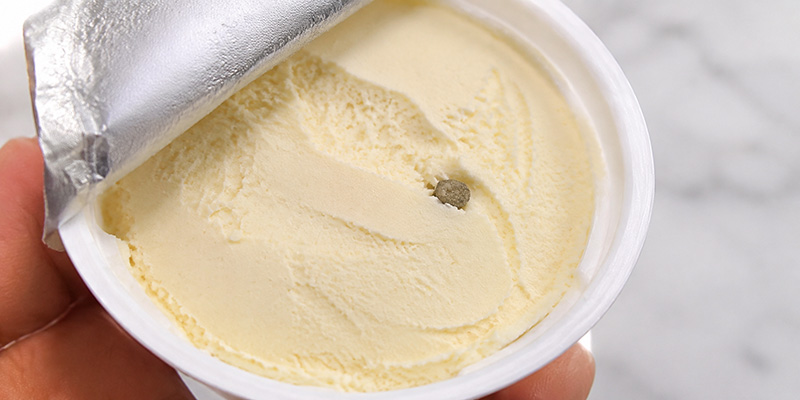
During the ice cream production process, foreign object contamination is a major quality control concern. Metal fragments, stones, and certain high-density plastic materials can potentially find their way into the product during ingredient handling, processing, or filling.
For manufacturers looking for a reliable X-ray inspection machine for food, choosing the right inspection configuration is essential. HISTOM provides food X-ray inspection equipment for different ice cream packaging formats, helping identify detectable foreign objects in finished products before they proceed to distribution.
2.Foreign Object Risks in Ice Cream Products
During the handling of ingredients, processing, and filling, foreign objects may inadvertently find their way into ice cream products. Depending on the production environment and the raw materials used, potential contaminants may include:
● Metal fragments: Ferrous, non-ferrous, or stainless steel particles originating from processing equipment or mechanical components.
● Stone particles: Dense foreign objects that may be introduced via raw materials or during the handling of ingredients.
● Plastic fragments: Certain types of plastic materials may be detectable, depending on their density, size, and contrast against the surrounding ice cream product.
For ice cream manufacturers, inspecting finished products after the filling and packaging stages provides an additional opportunity to identify potential foreign object contamination before the products are distributed.
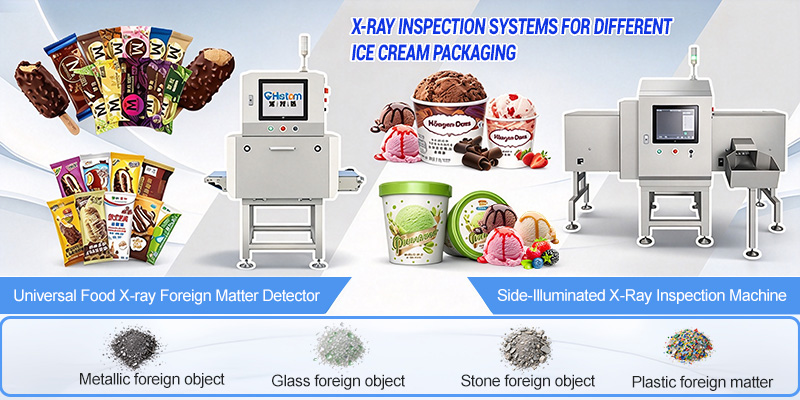
3.X-Ray Inspection Systems for Different Ice Cream Packaging
Different ice cream packaging formats require suitable X-ray inspection configurations. When evaluating an industrial X-ray inspection system, manufacturers should consider product dimensions, packaging structure, conveyor layout, and target contaminant types.
1.Side-Illuminated X-Ray Inspection for Individual Ice Cream Cups
For individually sealed ice cream cups without additional outer packaging, a Side-Illuminated X-ray inspection machine can be installed downstream of the filling and sealing equipment. Its side-view inspection configuration allows finished cups to be scanned according to their product dimensions and production line layout.
2.Food X-Ray Inspection for Bagged and Boxed Ice Cream
For bagged ice cream and products packed in outer containers, a food X-ray inspection machine can be configured for conveyor-based inspection. The system scans packaged products to identify potential foreign objects based on differences in material density.
How does X-ray inspection work?
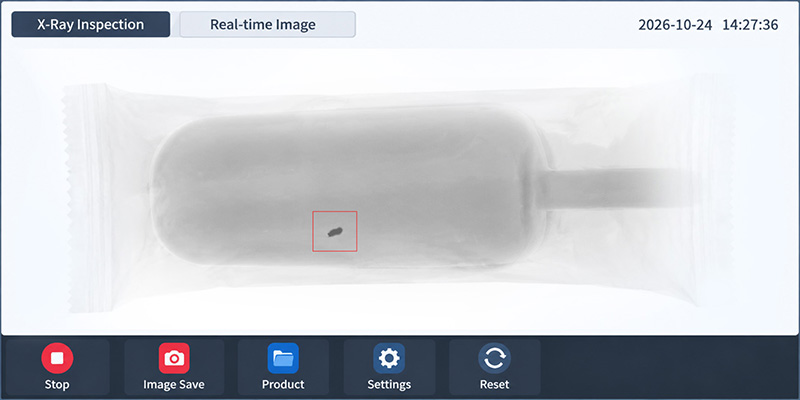
HISTOM’s X-ray inspection systems leverage the penetrating power of X-rays, combined with optoelectronic technology, computer systems, and digital signal processing, to identify and distinguish image data—thereby detecting high-density foreign objects mixed into products.
As packaged ice cream passes through the inspection channel, X-rays penetrate the product, generating an image for the system to analyze. Detection software processes this image, identifying potential foreign objects based on their specific X-ray characteristics and the contrast between them and the surrounding product.
Once a contaminant is detected, the system triggers an automatic rejection mechanism, removing the affected product from the production line.
This equipment utilizes low-dose X-ray inspection technology; the inspection process does not adversely affect the quality, taste, or safety of the ice cream products.
Advantages of X-ray Inspection
Foreign Object Detection: Capable of identifying contaminants such as metal, stone, and certain types of plastic (depending on the density and size of the contaminant, as well as its contrast against the product).
● Packaged Product Inspection: Allows for the inspection of finished ice cream products without the need to open the packaging.
● Flexible Inspection Configurations: Supports a wide range of packaging formats, including individual cups, pouches, and cartons.
● Automatic Rejection of Non-Conforming Products: Automatically removes defective items from the production line.
● In-Line Quality Control: Integrates with downstream production processes to enable continuous inspection.
Recommended model


4. Choosing the Right Inspection Solution for Ice Cream Production
Different inspection requirements call for different technologies. For ice cream manufacturers, X-ray inspection and aluminum foil seal inspection address two distinct aspects of finished-product quality control.
X-Ray Inspection: Recommended when the main requirement is detecting potential foreign objects inside finished ice cream products, including metal and certain detectable non-metallic materials.
Infrared Thermal Imaging Seal Inspection: Recommended when manufacturers need to monitor the sealing integrity of aluminum foil lids on ice cream cups and identify incomplete or missed sealing.
For production lines requiring both foreign object detection and packaging quality control, the two systems can be integrated at different stages of the production process to provide more comprehensive inspection coverage.
The final configuration depends on product packaging, production speed, installation space, and actual inspection requirements.
5. HISTOM Customized Inspection Solutions for Ice Cream
Every ice cream production line has unique inspection requirements. Factors such as product format, packaging materials, filling equipment, and production speed all influence the selection and configuration of an inspection system.
HISTOM provides customized inspection solutions tailored to your specific production environment, taking the following factors into account:
● Ice cream product type: Ice cream in cups, pouches, or cartons.
● Packaging format: Individual cups, flexible pouches, or outer cardboard cartons.
● Product dimensions: Cup diameter, product height, and the length and width of the packaging.
● Production speed: Conveyor belt speed and the required inspection throughput.
● Inspection requirements: Detection of foreign objects or verification of aluminum foil seal integrity.
● Rejection requirements: Configuration of an appropriate automatic rejection system based on the product type and production line layout.
Whether you require an X-ray inspection system for packaged ice cream or an infrared thermal imaging system for checking aluminum foil seals, HISTOM can help assess your production needs and recommend the most suitable solution.
6. Get an Ice Cream Inspection Solution for Your Production Line
Looking for a reliable way to detect foreign objects or inspect aluminum foil seals in ice cream products?
Contact HISTOM to discuss your product specifications, packaging format, and production line requirements. Our team can help you identify a suitable inspection configuration for your ice cream manufacturing process.
1.Common Sealing Defects in Ice Cream Cup Packaging
After ice cream is filled into cups, the cups are typically sealed with aluminum foil lids to protect the product during storage and transportation.
However, sealing defects can occur during the heat-sealing or electromagnetic induction sealing process. Common issues include:
● Incomplete sealing: Portions of the aluminum foil lid fail to form a proper seal with the rim of the cup.
● Failed sealing: The sealing process fails to create a complete seal around the cup rim.
● Uneven sealing: Inconsistent sealing conditions can lead to variations in the quality of the seal across different areas.
Such defects can compromise packaging integrity and increase the risk of product leakage or quality issues.
For ice cream manufacturers, inspecting the seal of each cup after the sealing process helps identify defective packaging before the products move on to the next stage of production.
2.Infrared Thermal Imaging Seal Inspection Solution
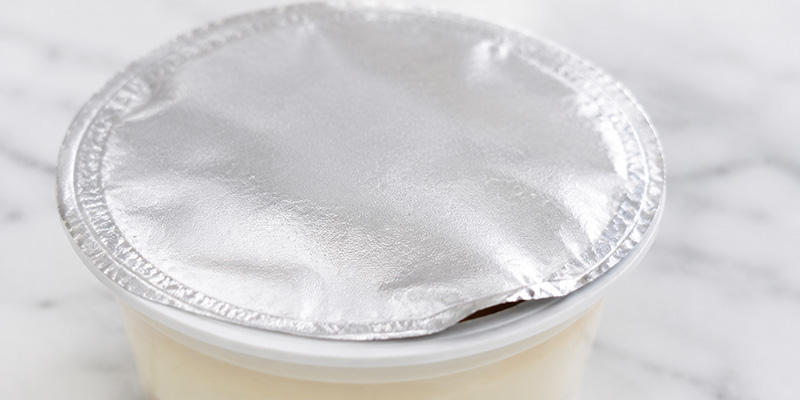
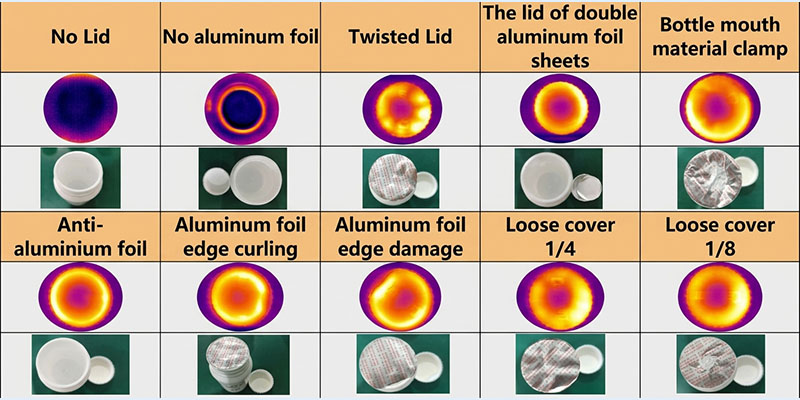
In the production of ice cream cups, incomplete aluminum foil sealing is a common packaging quality issue. Gaps in the sealed area or an uneven seal can compromise the integrity of the packaging and increase the risk of leakage.
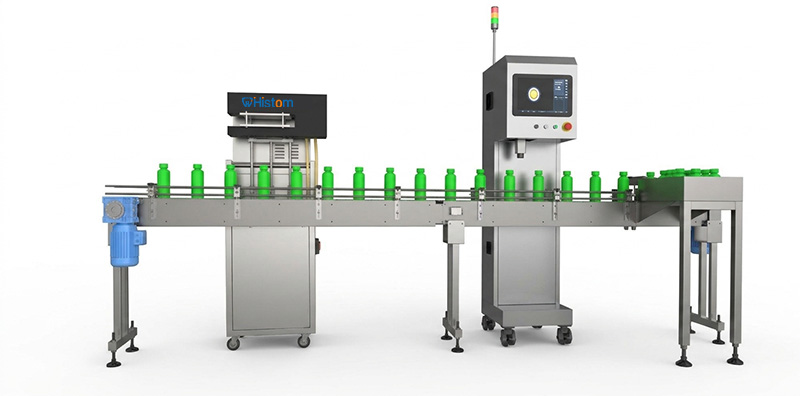
For manufacturers seeking inspection equipment for aluminum foil seals, HISTOM offers a solution based on infrared thermal imaging technology, specifically designed for in-line inspection following the filling and sealing processes. Containers—sealed via heat sealing or electromagnetic induction—are transported to an infrared thermal imaging inspection station. An infrared camera captures thermal images of the lids, which are then transmitted to a high-speed image processing system. By calculating and analyzing the temperature distribution patterns within these thermal images, the system determines whether each lid is acceptable or defective.
3.Working Principle of Aluminum Foil Seal Inspection Machines
The aluminum foil seal inspection system captures images of product seals and employs intelligent algorithms to compare them against preset quality standards, utilizing deep learning technology to assess seal integrity. An industrial computer handles data processing, while an automated controller coordinates the operation of various system components. When a defective seal is detected, the system automatically triggers a rejection mechanism to remove the faulty product from the production line, enabling automated, in-line inspection and quality control of the sealing process.
Benefits of Seal Inspection
● Incomplete Seal Detection: Helps identify sealing defects and missed sealing areas through thermal image analysis.
● Non-Contact Inspection: Inspects sealed aluminum foil lids without opening the packaging.
● Real-Time Thermal Analysis: Analyzes temperature distribution patterns to evaluate sealing conditions.
● Automatic Rejection: Separates products that do not meet established sealing criteria.
● Continuous Online Inspection: Supports automated quality control after the filling and sealing process.
Recommended model
4. Choosing the Right Inspection Solution for Ice Cream Production
Different inspection requirements call for different technologies. For ice cream manufacturers, X-ray inspection and aluminum foil seal inspection address two distinct aspects of finished-product quality control.
X-Ray Inspection: Recommended when the main requirement is detecting potential foreign objects inside finished ice cream products, including metal and certain detectable non-metallic materials.
Infrared Thermal Imaging Seal Inspection: Recommended when manufacturers need to monitor the sealing integrity of aluminum foil lids on ice cream cups and identify incomplete or missed sealing.
For production lines requiring both foreign object detection and packaging quality control, the two systems can be integrated at different stages of the production process to provide more comprehensive inspection coverage.
The final configuration depends on product packaging, production speed, installation space, and actual inspection requirements.
5. HISTOM Customized Inspection Solutions for Ice Cream
Every ice cream production line has unique inspection requirements. Factors such as product format, packaging materials, filling equipment, and production speed all influence the selection and configuration of an inspection system.
HISTOM provides customized inspection solutions tailored to your specific production environment, taking the following factors into account:
● Ice cream product type: Ice cream in cups, pouches, or cartons.
● Packaging format: Individual cups, flexible pouches, or outer cardboard cartons.
● Product dimensions: Cup diameter, product height, and the length and width of the packaging.
● Production speed: Conveyor belt speed and the required inspection throughput.
● Inspection requirements: Detection of foreign objects or verification of aluminum foil seal integrity.
● Rejection requirements: Configuration of an appropriate automatic rejection system based on the product type and production line layout.
Whether you require an X-ray inspection system for packaged ice cream or an infrared thermal imaging system for checking aluminum foil seals, HISTOM can help assess your production needs and recommend the most suitable solution.
6. Get an Ice Cream Inspection Solution for Your Production Line
Looking for a reliable way to detect foreign objects or inspect aluminum foil seals in ice cream products?
Contact HISTOM to discuss your product specifications, packaging format, and production line requirements. Our team can help you identify a suitable inspection configuration for your ice cream manufacturing process.
