Scenario 1: Visual Orientation Inspection Machine – Intelligent Image Recognition and Dynamic Mechanical Flip Correction
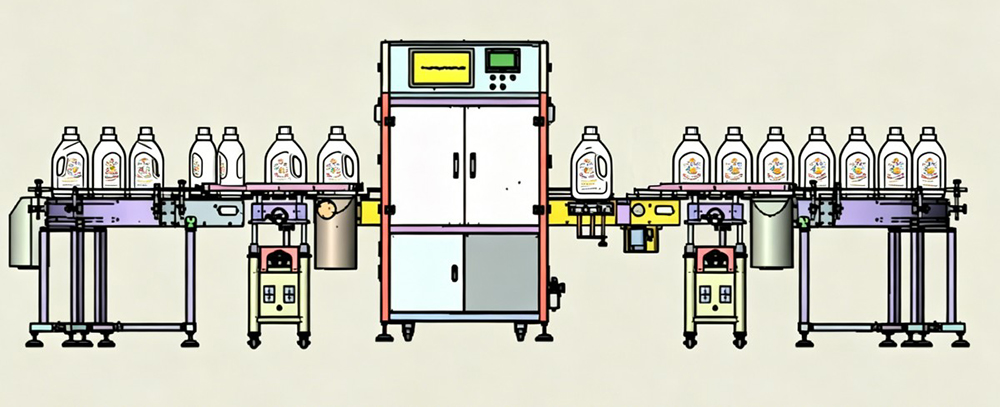
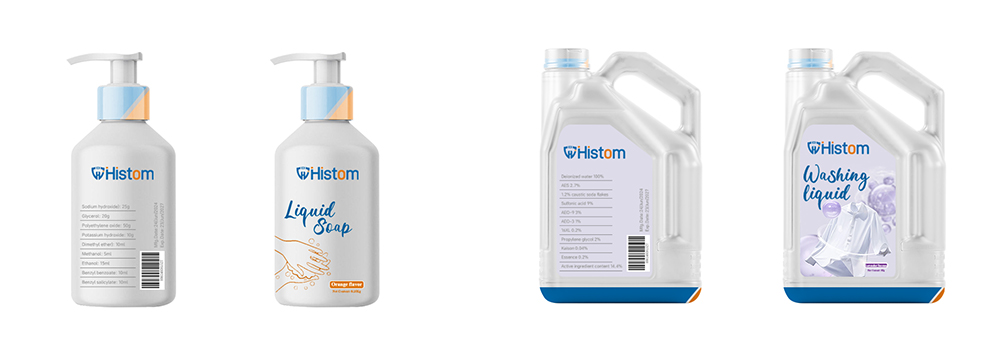
Application scenario: After filling and capping are completed, the bottles in the washing and care bottle filling line enter the front-end connection sections that require the same orientation, such as automated labeling machines, packing and palletizing
The camera captures images of bottles facing both directions, and an algorithm identifies and outputs signals. A customized flipping mechanism then rapidly rotates the bottles facing opposite directions, ensuring that all bottles in the subsequent section face the same direction. (Different flipping mechanisms are customized for different bottles, and specific flipping angles are calculated to guarantee uniform bottle orientation.)
Key Technological Aspects – From “Camera Image Acquisition” to “Linkage Control”: Traditional labeling error prevention is limited to “directly rejecting reversed bottles,” resulting in extremely high costs of repeated rework and manual bottle placement. Histom breaks with tradition by using an industrial camera to capture the geometric features of the flat bottle's outline or the deflection angle of the pump nozzle online. Through intelligent algorithms, it locks the bottle's current orientation within milliseconds. The system instantly outputs extremely precise motion control signals, powerfully driving the downstream “dynamic flipping mechanism” to smoothly and non-destructively correct reversed bottles, while forward-facing bottles pass unnoticed.
Recommended configuration: Visual orientation inspection machine - high-speed intelligent visual correction and control system for irregularly shaped bottles in daily chemical products (including: high frame rate industrial vision camera + edge computing industrial control host + linkage flip control hardware unit).
Application benefits: This system enables bottles to enter the labeling machine with the same face and direction throughout the entire production line, completely eliminating label waste caused by incorrect labeling. It also meets the orientation requirements during the final packing process, upgrading the production line that originally relied on manual bottle handling into a highly automated, unmanned factory.
Recommended model

Scenario 2: Post-capping and labeling process – Capping defects, liquid level discrepancies, and label detection
Application scenario: Before finished product output after filling, capping, and labeling.
Key pain points: Personal care products often have properties that make them foam easily and have high viscosity. Misaligned pump heads or loose caps can cause large-scale leakage and contamination; backflow of air bubbles after filling with the filling valve may lead to insufficient liquid level; misaligned or tilted labels, missed spraying, or unclear production dates or batch numbers can result in defective products entering the market, leading to penalties.
Recommended model
Testing items:
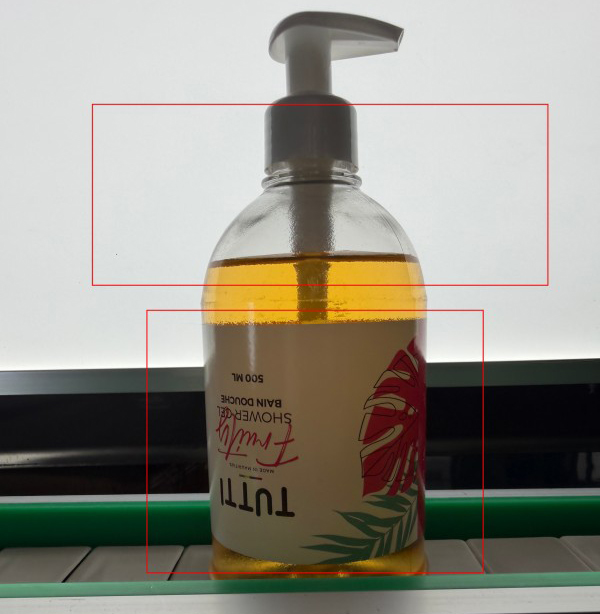
High cap/crooked cap detection: The vision system uses a baseline algorithm to calculate the vertical distance and tilt angle between the top of the cap/pump head and the bottle mouth step in real time. If the angle exceeds the preset threshold or the height difference exceeds the standard (indicating that it is not tightened), it is directly judged as a defective product, and the subsequent pneumatic or push rod rejection mechanism is triggered instantly.
Liquid level detection: Visual light source illuminates the liquid level on the semi-transparent or transparent shampoo bottle, the camera captures the image, and the algorithm identifies and avoids interference caused by shaking during transportation, extracts the true liquid level boundary line, and accurately rejects products that are underfilled or insufficiently filled.
Labeling verification: A camera is used to capture images of the entire bottle. The images are then used to identify and verify the positional deviations and misalignments of the labels before and after verification, as well as wrinkles, air bubbles, and edge curling caused by uneven labeling pressure.
OCR inkjet printing recognition and control: It performs image feature expansion and grayscale enhancement on the production date and batch number on the bottle or label, identifies and intercepts unprinted codes, incomplete codes, and overlapping characters, and strongly avoids the risk of non-compliance when leaving the factory.