Common Sources of Metal Contamination in Food Production
Metal contamination is one of the potential foreign-object risks in food production. Metal fragments can enter food products at different stages, from raw material handling to processing, packaging, and transportation.
Understanding the common sources of metal contamination in food production can help food manufacturers identify potential risks and establish effective inspection procedures. A reliable food metal detector can provide an additional control point by detecting metallic contaminants before affected products reach consumers.
Where Can Metal Contamination Come From?
Metal contamination can originate from raw materials, processing equipment, maintenance activities, packaging materials, or other parts of a production environment.
Identifying these sources is an important step in developing an effective food safety and quality control system.
1. Processing Equipment Wear and Damage
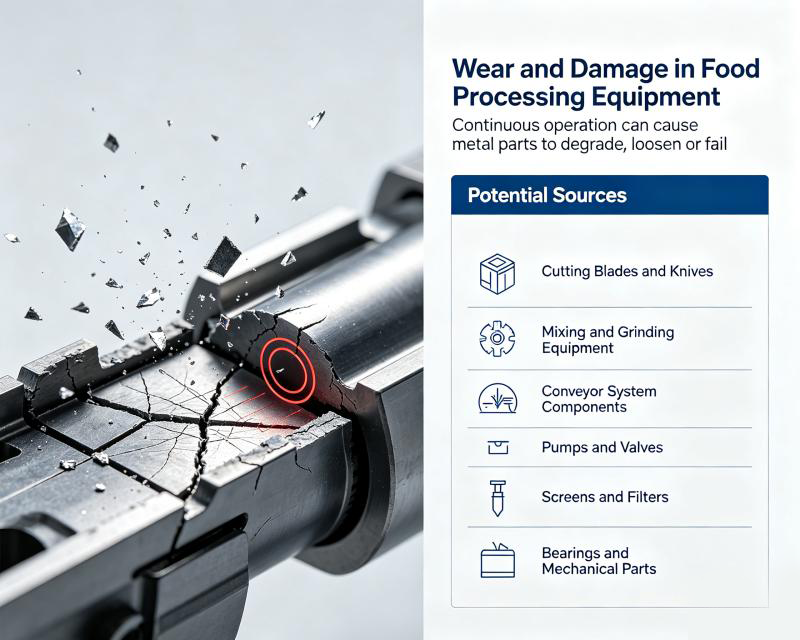
Food processing equipment operates continuously and may contain numerous metal components. Over time, mechanical parts can wear, loosen, or become damaged.
Potential sources include:
● Cutting blades and knives
● Mixing and grinding equipment
● Conveyor components
● Pumps and valves
● Screens and sieves
● Bearings and machine parts
For example, a damaged cutting blade may produce small metal fragments that become mixed with food during processing.
Regular equipment inspection and maintenance can help reduce these risks. However, because unexpected equipment failures can still occur, installing a metal detector for food processing can provide an additional inspection step.
2. Metal From Raw Materials
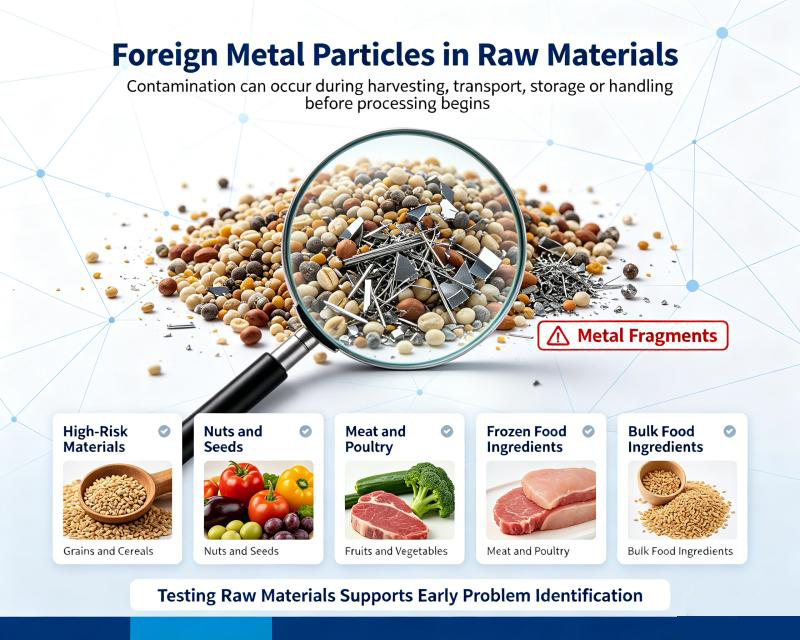
Metal contamination does not always originate inside the production line. Raw materials entering a factory may already contain foreign metal particles.
During harvesting, transportation, storage, or handling, food materials can come into contact with metal objects or equipment.
This can be particularly important for products such as:
● Grains and cereals
● Nuts and seeds
● Fruits and vegetables
● Meat and poultry
● Frozen food ingredients
● Bulk food materials
Inspecting raw materials or intermediate products can help manufacturers identify contamination at an earlier stage of production.
3. Broken or Damaged Machine Components
Unexpected mechanical failures can introduce metal fragments into food products.
Loose screws, broken wires, damaged screens, or worn machine components may become potential sources of contamination.
In high-speed production environments, even a small damaged component can affect a large quantity of products if the problem is not identified quickly.
A properly positioned food metal detection system can continuously inspect products and automatically reject contaminated items.
4. Maintenance and Repair Activities
Maintenance is essential for keeping food production equipment operating safely. However, maintenance activities can also introduce potential foreign-object risks if they are not properly controlled.
Tools, screws, nuts, bolts, wires, and other metal components may accidentally enter the production area during repair or equipment adjustment.
Food manufacturers should therefore establish appropriate procedures for maintenance activities, including tool control, equipment checks, and production-line inspection before restarting operations.
A food processing metal detector can provide an additional verification step after maintenance or equipment servicing.
5. Metal From Sieves, Screens, and Filters
Many food production processes use sieves, screens, and filters to control particle size or remove unwanted materials.
These components can experience mechanical stress during continuous operation. Broken wires or damaged metal mesh may potentially become foreign objects in the food product.
Because these components are often directly involved in material processing, manufacturers should regularly inspect them for wear or damage.
Installing metal detection after critical processing stages can help identify metallic contamination before products move further through the production line.
Where Should Metal Detection Be Used?
The best inspection point depends on the production process and potential contamination sources.
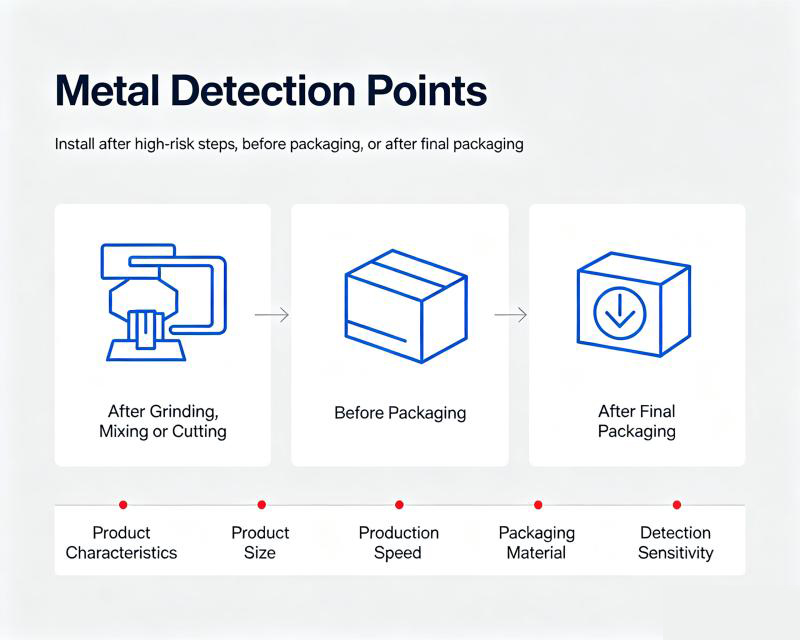
A metal detector may be installed after grinding, mixing, cutting, or other high-risk processing stages. It can also be installed before packaging or after final packaging as a finished-product inspection.
For some production lines, multiple inspection points may be used to provide additional control throughout the manufacturing process.
The detector should be selected according to product characteristics, product size, production speed, packaging material, and required detection sensitivity.
Why Is Continuous Metal Detection Important?
Manual inspection cannot reliably examine every product on a high-speed production line.
An automatic metal detection system can continuously inspect products as they pass through the detection aperture. When a metal contaminant is identified, the connected rejection system can remove the affected product from the production flow.
This helps manufacturers maintain consistent inspection while reducing dependence on manual checks.
For food manufacturers producing packaged foods, snacks, meat products, bakery products, frozen foods, sauces, grains, and other products, automated metal detection can become an important part of the overall quality control process.
Conclusion
Metal contamination in food production can come from many different sources, including raw materials, processing equipment, broken machine components, maintenance activities, screens, filters, and packaging equipment.
Understanding these potential sources allows food manufacturers to identify high-risk stages and establish appropriate preventive and inspection measures.
Regular maintenance and good production practices can reduce the likelihood of contamination, while a reliable food metal detector provides an additional layer of protection by detecting and rejecting metallic contaminants during production.
By combining preventive controls with continuous metal detection in food processing, manufacturers can build a more reliable food safety and quality control system.
Let's Customized Your Inspection Solution
Every production line is unique. Our experts will help you design a vision inspection system tailored to your products, packaging formats, and quality requirements.


