How can bread manufacturers prevent baked goods contaminated with metal from reaching the market?
Bread is one of the most widely produced baked goods, encompassing items such as sandwich loaves, soft sweet breads, and a variety of everyday bakery products. During production, metal contamination can occur due to the wear and tear of mixing equipment, damage to machine components, or the presence of metal fragments within raw materials. Even the smallest metal particles pose food safety risks, which can lead to customer complaints, product recalls, and potential damage to a manufacturer’s reputation.
Why is metal detection important in the bread production process?
Bread production involves multiple processing stages, such as ingredient mixing, dough preparation, shaping, baking, cooling, and packaging. During these operations, metal particles may enter the product due to equipment wear or contamination within the raw materials.
Common potential sources include:
● Equipment wear: Long-term, repetitive operation can lead to mechanical wear, which may result in metal fragments ending up in the dough.
● Processing components: Damaged or worn machine parts can pose a risk of metal contamination.
● Raw materials: Foreign metal particles may occasionally be present in the raw materials sourced for production.
Without effective detection measures, contaminated products could continue along the production line and ultimately reach the consumer. Therefore, food manufacturers must establish robust inspection processes to identify and remove any products containing metal contaminants.

Where should a metal detector be positioned to best suit a production line?
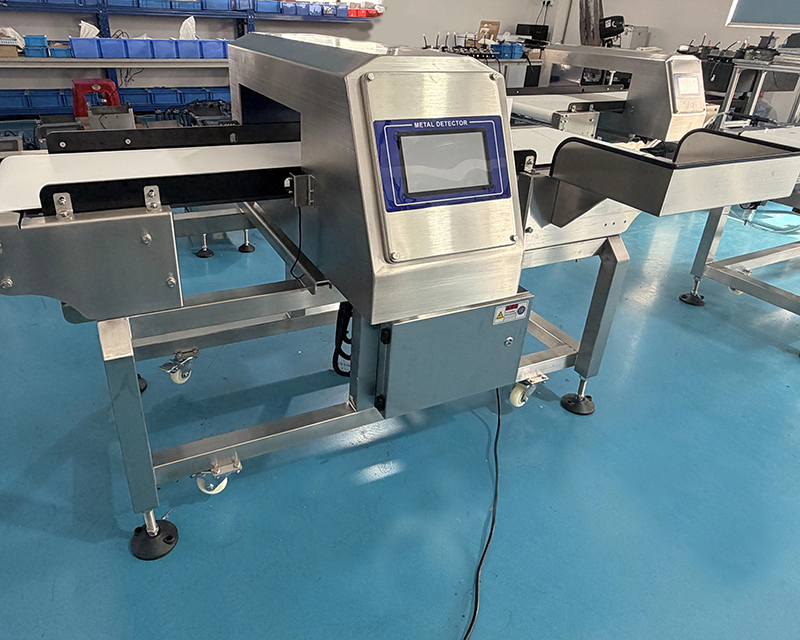
For packaged bakery products, installing a conveyor metal detector after the packaging stage adds an extra layer of inspection before the products leave the production line.
At this stage, the inspection system screens every packaged item to detect the presence of ferrous metals, non-ferrous metals, or 304 stainless steel. If a metal contaminant is identified, a pre-configured rejection system automatically separates the contaminated product from the acceptable ones.
However, when selecting an inspection system, it is also necessary to consider the packaging materials. Certain types of packaging—or specific product characteristics—can affect detection performance. For instance, if the packaging consists of aluminum foil, a conventional metal detector may be impacted by the material, which can compromise its accuracy.
Histom Metal Detector for Bakery Products: Technical Specifications
Histom provides metal detection equipment for the inspection of packaged food products (including those in bakery production applications).
Standard unit configurations include:
|
Technical Parameter |
Specification |
|
|
Detection channel width |
220mm |
|
|
Detection channel height |
100mm |
|
| Conveyor belt speed |
30m/min |
|
|
Sensitivity |
FE |
1.2mm |
|
NFE |
2mm |
|
|
SUS304 |
2.5mm |
|
| Conveyor belt material | Food-grade PU belt | |
|
Rejector |
Air Blast/ Pusher/ Swing Arm/ Flip Down/ Diversion Rejector |
|
| Protection Rating | IP65 | |
|
Main Materials |
SUS304 Stainless Steel |
|
These technical specifications serve as a practical reference for manufacturers when evaluating production line equipment.
The standard inspection aperture measures 220 mm in width and 100 mm in height.
If the dimensions of the bread or its packaging specifications differ, the inspection tunnel can be custom-designed to meet specific product requirements, or an alternative equipment model may be selected.
Detection sensitivity may vary depending on product characteristics, packaging materials, equipment configuration, and operating conditions.
Automatic Rejection Options for Products
Detecting metal contaminants is only one part of the inspection process; removing contaminated products from the production line is equally critical.
Depending on production requirements, Histom metal detectors can be configured with various rejection mechanisms:
● Air Blast Rejection: Uses compressed air to blow or push the affected product off the conveyor belt.
● Pusher Rejection: Employs a mechanical pusher to remove contaminated products from the production line.
● Diverter/Flap Rejection: Utilizes a movable flap or diverter mechanism to redirect the rejected product to another area.
● Alarm and Stop: Triggers an alarm and halts the conveyor belt when a metal contaminant is detected.
The choice of rejection method depends on factors such as product weight, packaging dimensions, conveyor belt speed, and the specific requirements of the production line.
How to Choose the Right Metal Detection System for Bakery Products?
When selecting metal detection equipment for bakery products, manufacturers should look beyond mere detection sensitivity.
First, the dimensions of the baked goods and their packaging must be evaluated to ensure the detection aperture is appropriately sized. Second, production line speed should be considered, and the conveyor system must be compatible with existing packaging processes. Third, specific performance requirements for detecting various types of contaminants—such as ferrous metals, non-ferrous metals, and stainless steel—should be clearly defined.
Furthermore, factors such as the rejection mechanism, equipment materials, and ingress protection (IP) ratings must be taken into account, especially in food processing environments that require regular equipment cleaning.
For manufacturers handling a variety of product sizes or different types of packaging, a custom-sized detection aperture may offer a more optimal solution.
Enhancing Bakery Food Safety with Histom
Efficient metal detection helps bakery businesses strengthen foreign object control and reduces the risk of contaminated products reaching consumers.
Histom’s metal detection solutions are suitable for a wide range of packaged bakery products. The equipment can be customized in size and offers various rejection configurations to meet diverse production requirements.
Explore our metal detector for packaged food, and learn more about our technical specifications and inspection solutions for food production lines.
Let's Customized Your Inspection Solution
Every production line is unique. Our experts will help you design a vision inspection system tailored to your products, packaging formats, and quality requirements.


