How Does a Food Metal Detector Work?
Metal contamination is a potential risk in food production. Metal fragments can enter food products from raw materials, processing equipment, cutting tools, conveyors, or damaged machine components.
A Food Metal Detector provides an automated way to identify metallic contaminants during production. By using electromagnetic technology to detect changes caused by metal, the system can inspect products continuously and automatically remove contaminated products from the production line.
What Is a Food Metal Detector?
A Food Metal Detector is an inspection machine designed to detect metal contaminants in food products. Depending on the system and application, it can detect ferrous metals, non-ferrous metals, and stainless steel.
The equipment is commonly installed on a conveyor production line, allowing products to pass through the detector one by one.
When a metal contaminant is detected, the system sends a signal to the rejection mechanism. The contaminated product can then be automatically removed while qualified products continue through the production process.
How Does a Food Metal Detector Work?
The working principle of a food metal detector is based on an electromagnetic field.
Inside the detector is a sensing coil that generates an electromagnetic field. When a food product passes through the inspection aperture, the system continuously monitors changes in this field.
If a metal fragment enters the detection area, it changes the electromagnetic signal. The control system analyzes this signal and determines whether the detected object meets the predefined detection criteria.
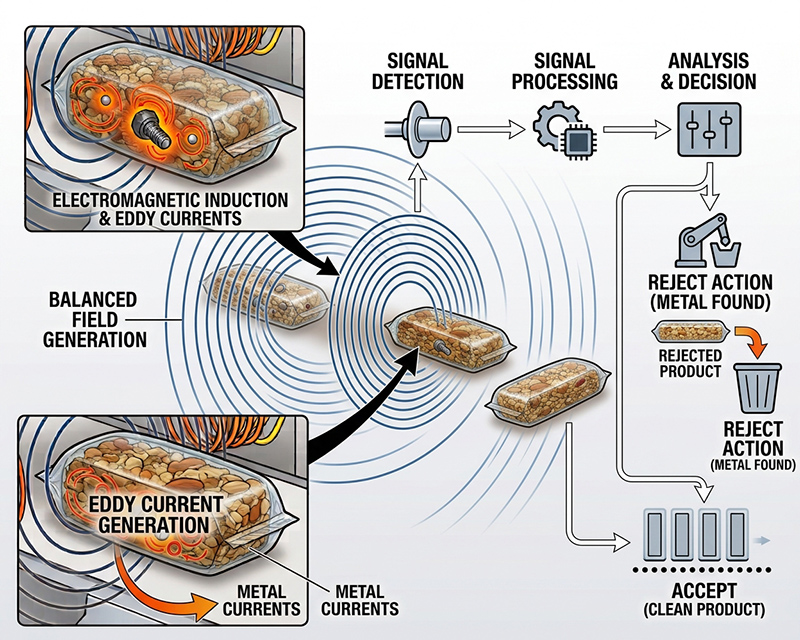
When metal contamination is confirmed, the system can trigger an alarm and activate an automatic reject device.
The basic inspection process can be summarized as:
Product Feeding → Electromagnetic Detection → Signal Analysis → Metal Identification → Automatic Rejection
This allows manufacturers to perform continuous inspection without manually checking every product.
What Is a Metal Detector Conveyor System?
A metal detector conveyor system combines metal detection with a conveyor for automated product inspection.
Products are transported through the detection aperture at a controlled speed. If a contaminated product is identified, the system can automatically activate a suitable rejection mechanism.
Different rejection methods can be selected according to the product and production line, including air blast, pusher, flap, or other customized solutions.
This type of system is particularly suitable for packaged foods and other products that can be transported continuously on a conveyor.
Why Use an Industrial Metal Detector?
An industrial metal detector is designed for continuous operation in demanding production environments.
Food manufacturers often operate production lines for many hours each day, making reliable and consistent inspection essential. An industrial system can be integrated with existing conveyors and packaging equipment to provide automated metal contamination control.
Food metal detection systems can be used for a wide range of applications, including:
● Meat and poultry
● Bakery products
● Snacks
● Frozen foods
● Dairy products
● Grains and cereals
● Powdered foods
● Pet food
● Packaged foods
The appropriate system depends on the product characteristics and production requirements.
Where Should a Food Metal Detector Be Installed?
The ideal installation position depends on the production process and potential contamination sources.
A metal detector may be installed after processing equipment such as mixers, cutters, or grinders to identify contamination introduced during production.
It can also be installed before packaging or after final packaging as a finished-product inspection point.
For some production lines, multiple inspection points can be used to provide additional control throughout the manufacturing process.
Conclusion
A Food Metal Detector works by generating an electromagnetic field and analyzing changes caused by metallic contaminants as products pass through the inspection area.
When integrated into a metal detector conveyor system, the equipment can continuously inspect products and automatically reject contaminated items without interrupting normal production.
For food manufacturers, an industrial metal detector or metal detector machine for food can provide an important layer of automated food safety and quality control.
The right system should be selected according to the product, packaging, production speed, detector aperture, required sensitivity, and rejection method. With the appropriate configuration, metal detection can become a reliable part of an automated food production line.
Let's Customized Your Inspection Solution
Every production line is unique. Our experts will help you design a vision inspection system tailored to your products, packaging formats, and quality requirements.


