How to Choose a Checkweigher for Packaged Food
Accurate product weight is essential for food manufacturers. Underweight packages may lead to customer complaints and compliance risks, while overweight products can increase material waste and production costs. Choosing the right checkweigher helps manufacturers maintain consistent product weight and improve packaging quality control.
However, different food products and production lines have different requirements. Before investing in a checkweigher for food packaging, manufacturers should consider several important factors, including product characteristics, weighing accuracy, production speed, and integration with existing equipment.
1. Consider Your Food Products and Packaging Types
The first step is to identify the types of products your production line handles. Packaged foods can vary significantly in size, weight, shape, and packaging material.
For example, a production line may handle snack bags, frozen food packages, bakery products, boxed foods, or packaged pet food. Each product may require a different conveyor configuration and weighing range.
A suitable Dynamic Checkweigher weighs products while they move along the production line, allowing manufacturers to inspect individual packages without stopping normal production.
When selecting equipment, consider the minimum and maximum product weight, package dimensions, product stability, and whether the machine can accommodate different product specifications.
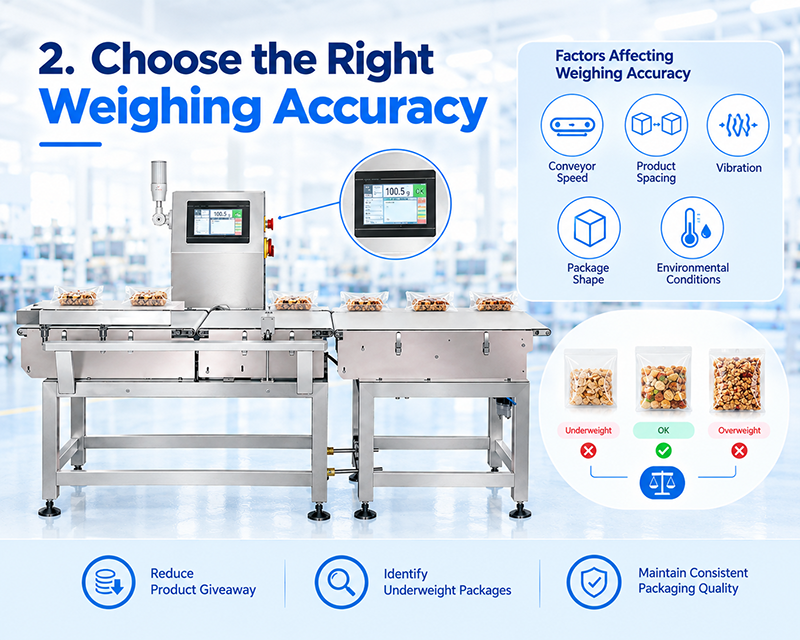
2. Choose the Right Weighing Accuracy
Weighing accuracy is one of the most important factors when choosing an automatic checkweigher. The system should identify products that fall outside the preset weight limits while maintaining stable performance during continuous operation.
Several factors can affect weighing accuracy, including conveyor speed, product spacing, vibration, package shape, and environmental conditions.
Manufacturers should evaluate the required weight tolerance and actual production conditions rather than selecting equipment based on a single accuracy specification. Product testing under realistic operating conditions can help determine whether a checkweigher meets the application's requirements.
Accurate weight inspection helps reduce product giveaway, identify underweight packages, and maintain consistent packaging quality.
3. Match the Checkweigher to Your Production Speed
Food packaging lines often operate at high speeds, so the checkweigher must match the required throughput.
A Dynamic Checkweigher measures each package as it passes over the weighing conveyor. To achieve reliable results, the equipment must be configured for the product size, package spacing, target speed, and weighing range.
For high-volume production, manufacturers should consider not only the maximum number of packages per minute but also the stability of the entire line. Smooth product transfer and consistent spacing help the weighing system deliver more reliable results.
Choosing a checkweigher that matches your production requirements can improve inspection efficiency without creating an unnecessary bottleneck.
4. Check the Automatic Rejection Function
Detecting an incorrect package weight is only part of the process. Products outside the preset limits may also need to be removed automatically.
Depending on the product and production line, a checkweigher can work with suitable rejection mechanisms, such as a pusher, air blast, or conveyor drop-down system.
The rejection method should match the package's weight, size, shape, and material. It should also remove the target product reliably without disturbing adjacent packages.
An integrated weighing and rejection process helps reduce manual handling and supports more consistent food packaging quality control.
5. Consider Integration with Other Inspection Equipment
A checkweigher is often part of a larger food quality control system rather than a standalone machine. Depending on production requirements, manufacturers may need to combine weight inspection with metal detection or X-ray inspection.
For example, a metal detector and checkweigher combination can inspect packaged food for metal contaminants and verify product weight within a connected production process. X-ray inspection may be suitable when additional foreign object detection is required.
When planning an inspection line, consider the available installation space, conveyor height, product transfer, control interfaces, and rejection arrangements.
Explore Histom's food inspection solutions to see how inspection equipment can be selected for different food products and production processes.
6. Choose a Supplier That Understands Your Production Needs
The right equipment should fit your actual production requirements, not just the specifications on a product sheet.
Before making a decision, provide the supplier with details such as product samples, package dimensions, weight range, required production speed, and the types of inspection needed. Testing representative products can help verify performance and identify the appropriate configuration.
Histom's Dynamic Checkweigher is designed for in-line weight inspection of packaged products. Depending on the application, the equipment can support automatic weight checking, out-of-tolerance product rejection, and integration into existing food packaging lines.
Learn more about Histom's Dynamic Checkweigher to explore the product configuration and determine whether it suits your production requirements.
Conclusion
Choosing the right checkweigher for packaged food involves more than comparing weighing specifications. Product characteristics, accuracy requirements, production speed, rejection methods, and line integration all influence the final choice.
A properly configured Dynamic Checkweigher can help food manufacturers improve weight consistency, reduce product giveaway, and strengthen packaging quality control. By evaluating real production conditions and testing representative products, manufacturers can select a solution that supports both operational efficiency and reliable product inspection.
Let's Customized Your Inspection Solution
Every production line is unique. Our experts will help you design a vision inspection system tailored to your products, packaging formats, and quality requirements.


