Automated Label Inspection for Packaged Products
In modern manufacturing and packaging production lines, accurate product coding is essential for product identification, traceability, and quality control. Information such as production dates, expiration dates, batch numbers, and barcodes enables manufacturers to effectively manage products throughout the entire supply chain and streamline warehousing processes.
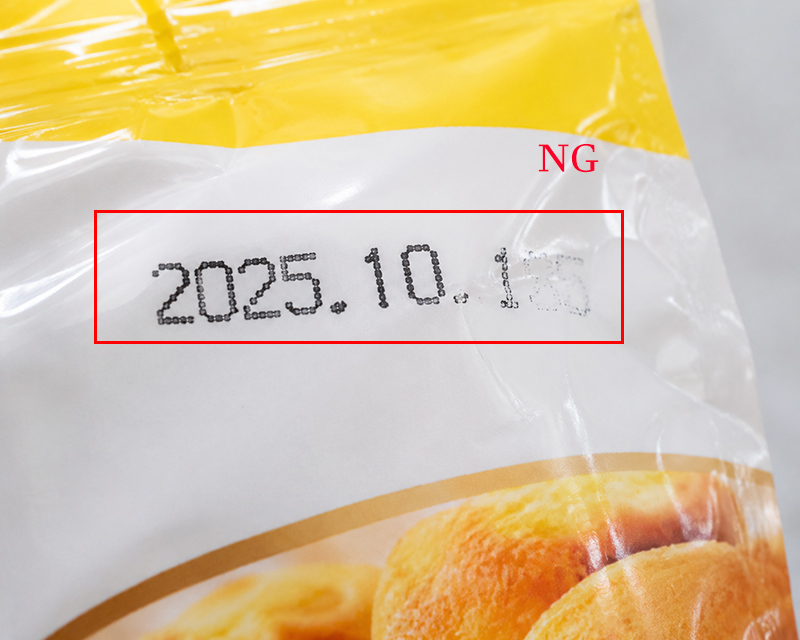
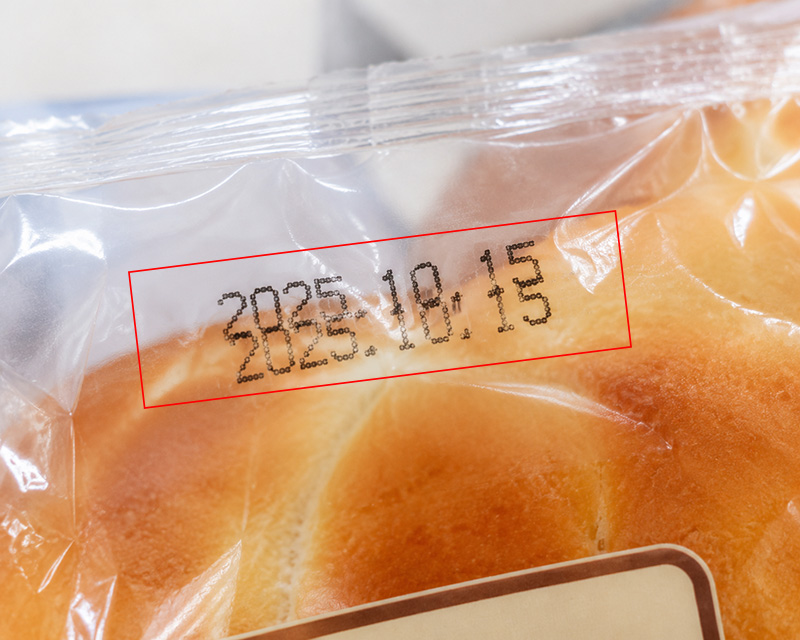
However, defects can inevitably occur during the coding stage of production. For instance, an inkjet printer might produce blurred or incomplete characters, the print position might be misaligned, or codes could be incorrect or missing entirely—issues that are often difficult to detect during high-speed packaging operations. Such defects can lead to customer complaints, product rejection by the market, difficulties in product identification, and increased costs associated with additional inspection or rework.
Consequently, label inspection systems—utilizing vision technology—can perform real-time checks on the information printed on packaged products, helping manufacturers identify and address these issues promptly.
Why is it necessary to inspect product coding on packaging?
Product coding is a critical component of quality control in packaging. Even if the packaging itself is intact, errors or illegibility in the printed information can compromise product traceability and, consequently, erode customer trust.
Common issues with packaging codes include:
Missing production dates: The printing system fails to apply the required date or batch information.
Blurred or indistinct printing: Poor print quality makes the characters difficult to read.
Incorrect coding: The printed information does not match the actual production data.
Misaligned printing: The code appears outside the designated inspection area.
Incomplete or garbled characters: Characters are partially missing or overlapping, rendering the code unreadable.
Without an effective inspection process, non-compliant packaging may continue to move along the production line. Furthermore, when products move at high speeds, manual visual inspection is often unable to detect every defective item.
For these reasons, many manufacturers are turning to automated label inspection solutions to improve the quality of packaging codes and reduce reliance on manual checks.
How does a label vision inspection system work?
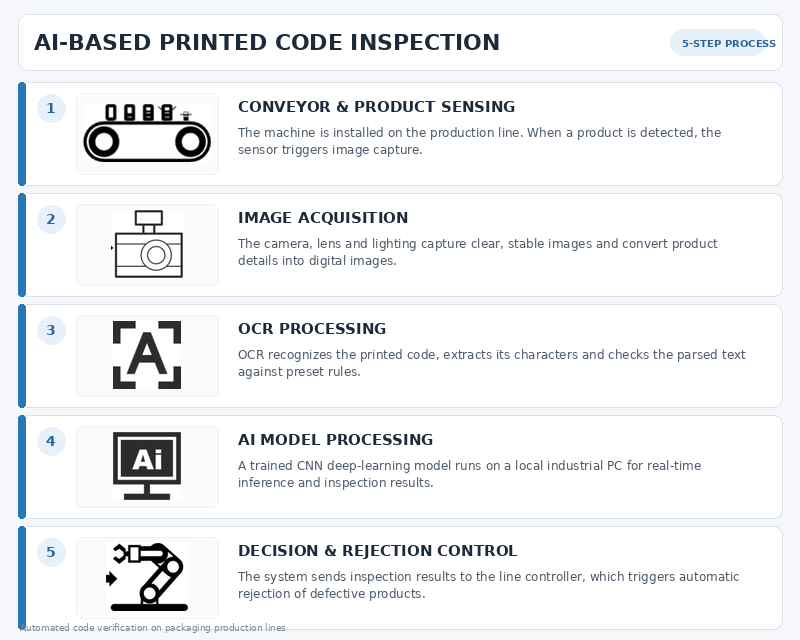
A label vision inspection system uses cameras and image processing technology to capture and analyze information printed on products as they move along a production line.
During operation, products pass through an inspection station, where the vision system captures images of the designated areas containing printed information. Artificial intelligence (AI)-based vision recognition technology then analyzes these images to detect predefined defects—such as missing, blurred, misaligned, or incorrect information.
If a product fails to meet inspection standards, the system’s display will indicate an "NG" (not good/fail) result and highlight the specific area containing the error. The system can also trigger an automatic rejection mechanism to separate the non-compliant packaging from the acceptable products.
This inspection method enables manufacturers to continuously monitor the quality of printed information and improve overall production efficiency.
Applications of Label Inspection Machine
Automated label inspection equipment can be deployed in various packaging environments that require the verification of printed information.
Typical application scenarios include:
Boxed products: Inspecting production dates, batch codes, and other printed information on cartons and various types of boxed goods.
Food packaging: Verifying the presence of production dates and other product codes on food packaging, as well as assessing the quality of the print.
Bottled products: Inspecting production dates and barcode information on bottled items.
Cartons and outer packaging: Verifying codes on large-scale packaging used in manufacturing and logistics/distribution.
The specific inspection configuration depends on factors such as product shape, dimensions, the print area, the format of the codes, and the layout of the production line.
Histom Vision Label Inspection Machine
Histom provides an automatic inkjet coding inspection machine designed to inspect printed codes on packaged products.
The system uses AI vision recognition to capture and evaluate coding information, helping manufacturers identify printing defects during production.
Key equipment specifications include:
|
Detection speed |
Max: 200pcs/min |
|
Detection method |
Testing on the production line |
|
Detection type |
Visual Inspection Inkjet Coding |
|
Culling method |
Push rod, air blow, lever type, etc. |
|
Body material |
304 stainless steel |
The system can achieve a detection speed of up to 200 products per minute, meeting the requirements for continuous inspection on packaging production lines. The actual operating speed will depend on factors such as product dimensions, the characteristics of the codes being inspected, and the specific operating conditions of the production line.
Depending on product characteristics and production requirements, the rejection system can be configured with various mechanisms, such as pushers or air-blast ejectors. Furthermore, the equipment height and the rejection method can be customized to suit different packaging production line layouts.
We also provide remote guidance to assist customers with equipment operation and offer ongoing technical support.
Where is the most appropriate location to install a label inspection machine?
Label inspection machines are typically installed after the coding (marking) and packaging processes, but before the products enter the cartoning, case packing, or final packaging stages. In this position, a vision system can inspect printed information—such as production dates, batch numbers, and barcodes—as products move along the conveyor belt. If any defects are detected—such as missing, illegible, misaligned, or incorrect codes—the system can automatically reject the non-compliant products, preventing them from moving on to the next stage of production. This setup helps manufacturers improve quality control in packaging and reduces the risk of products with coding defects reaching the market.
Enhancing Packaging Quality Control with Label Inspection Systems
Missing production dates, blurred printing, and incorrect product codes can create unnecessary quality control challenges for manufacturers.
Whether for boxed goods, pre-packaged food, or bottled liquids, a comprehensive vision inspection solution ensures consistent coding quality and optimizes production management.
Learn more about Histom’s Erection Type Inkjet Coding Inspection Machine and explore our Bottle and Jar Packaging Inspection Solutions.
Let's Customized Your Inspection Solution
Every production line is unique. Our experts will help you design a vision inspection system tailored to your products, packaging formats, and quality requirements.


