How to Detect Foreign Objects in Nuts, Grains and Seeds?
Nuts, grains, and seeds are typically processed in large, bulk quantities. During harvesting, transportation, and processing, foreign objects—such as stones, glass fragments, metal pieces, and hard clumps of soil—can become mixed into the raw materials. Even after a cleaning stage, some contaminants may remain. Consequently, detecting these foreign objects is essential for safeguarding product quality and mitigating risks in food production; it prevents contaminated products from reaching the market, which could otherwise lead to large-scale product recalls.
For processors handling large volumes of loose materials, a Bulk Food X-Ray Inspection Machine provides an online inspection method that can identify certain dense foreign objects before products move to the next processing stage.
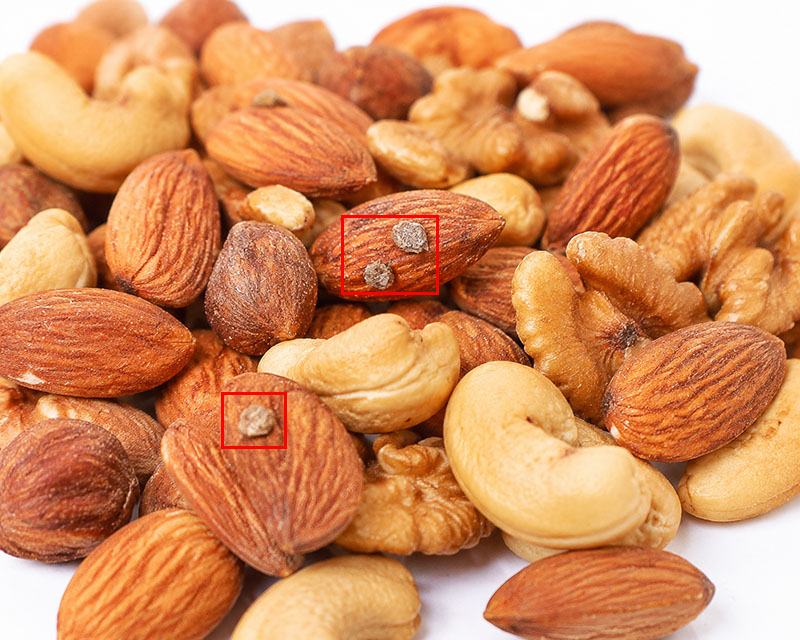
Common Foreign Objects in Nuts, Grains, and Seeds
Foreign objects can find their way into bulk food products at various stages of the production process.
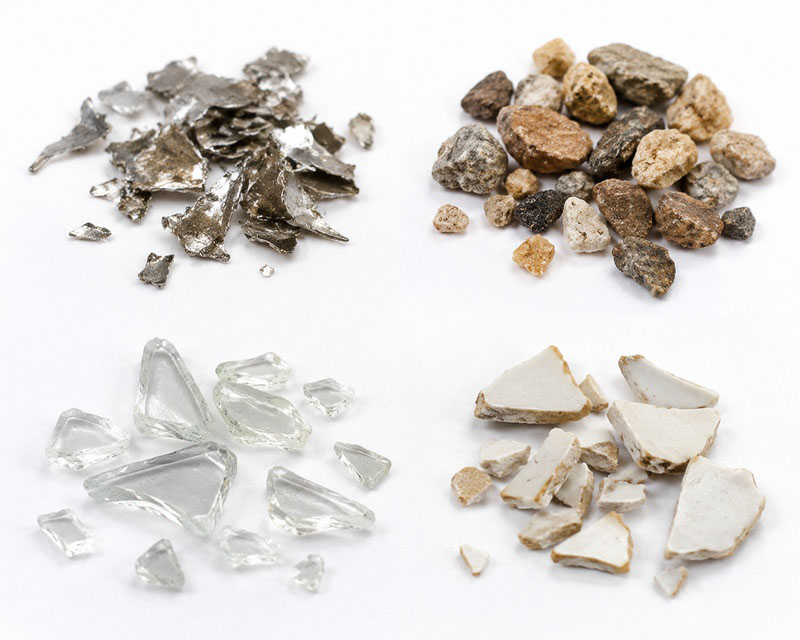
● Stones and hard soil clods: These may be introduced during crop harvesting or field collection.
● Metal fragments: These can originate from the wear and tear of harvesting, conveying, or processing equipment.
● Glass and ceramic shards: These may enter the product during handling, storage, or processing.
● Other impurities: Plant stems, insects, and damaged kernels can also compromise the quality of the raw materials.
When small stones or glass shards are similar in size to the food particles, removing them through basic screening alone is difficult. Furthermore, as processing volumes increase, manual sorting is no longer a practical solution.
Why might traditional inspection methods be insufficient?
Screens and sieving equipment primarily separate materials based on particle size. However, they may not remove all contaminants—especially when foreign objects are similar in size to the nuts, seeds, or grains being processed.
While metal detectors can identify metallic contaminants, they cannot detect non-metallic foreign objects such as stones, glass, or ceramics. Furthermore, product characteristics—such as moisture content, salt levels, or other product-related signals—can interfere with detection performance.
For bulk materials that are mixed or stacked irregularly, inspection coverage and the way the material is presented are also critical. If the material layer is too thick or unevenly distributed, overlapping particles can cause foreign objects to be obscured in X-ray images.
This is why many processors consider X-ray for bulk food inspection as an additional foreign object control step.
How Does X-Ray Inspection Work for Bulk Food?
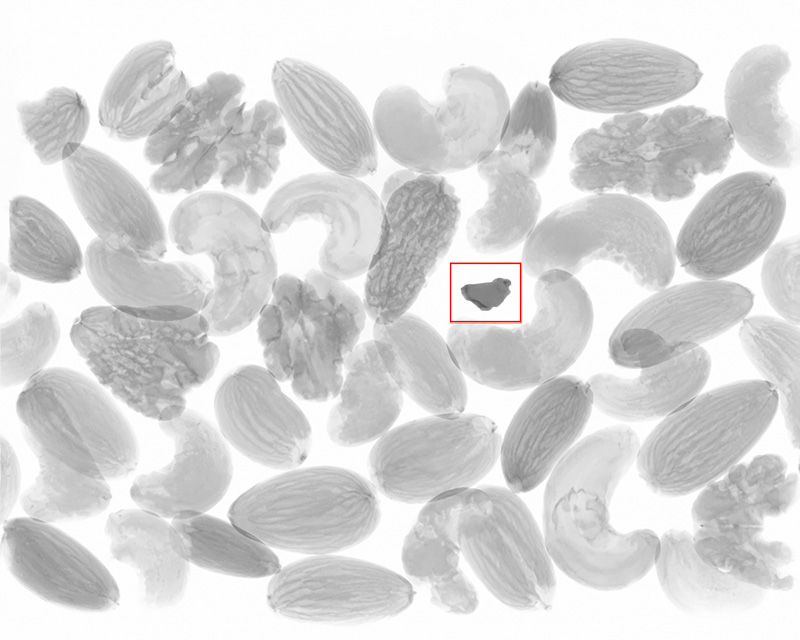
A food X-ray machine examines loose products as they pass through the inspection area on a conveyor belt. It analyzes differences in X-ray absorption between the food and potential foreign objects.
Materials with varying densities and absorption characteristics produce distinct signals in inspection images. The system processes these images to identify foreign objects that fall within its detection capabilities.
Depending on the specific product and validated inspection parameters, X-ray inspection systems for bulk materials can detect the following contaminants:
● Metal fragments
● Stones and hard clumps of soil
● Glass fragments
● Ceramic materials
The system can then trigger an automatic air-blast rejection mechanism to remove the contaminated material.
What Should You Consider When Choosing a Bulk Food X-Ray Inspection Machine?
When selecting a Bulk Food X-Ray Inspection Machine, processors should consider several practical factors.
1. Throughput Capacity
The equipment must align with the required production output. Histom’s X-ray inspection system for bulk materials has a nominal throughput of approximately 2–6 tons per hour, with a conveyor belt speed adjustable between 10 and 100 meters per minute. Actual throughput depends on the type of material, product presentation, and specific inspection requirements.
2. Detection Capability
The system’s reference detection standards include: 0.3 mm stainless steel spheres, 0.2 × 2 mm stainless steel wires, 1.0 mm ceramic fragments, and 1.0 mm glass fragments. Actual detection performance should be verified under expected operating conditions using representative product samples and contaminants.
3. Rejection and Product Loss
An air-blast rejection system is typically suitable for bulk items such as nuts, grains, and seeds. It removes detected contaminants from the product flow while minimizing the amount of good product inadvertently rejected alongside them. Rejection parameters should be adjusted based on product size and material flow characteristics.
4. Sanitation and Operation
Equipment used for bulk food products must facilitate regular cleaning. A removable conveyor belt simplifies both cleaning and maintenance. Additionally, Histom’s system features a 304 stainless steel chassis, a 17-inch color touchscreen, remote assistance capabilities, and the capacity to store up to 100 product presets.
Reducing Food Waste with X-Ray Inspection
The rejection of foreign objects should not come at the cost of unnecessarily discarding a large number of acceptable products.
properly configured bulk product X-ray inspection system helps processors identify suspect materials and remove them automatically rather than relying entirely on manual sorting. An appropriately adjusted air-jet rejection system can further reduce the amount of acceptable product lost during removal.
Detection performance should be evaluated using actual production samples—including both acceptable products and samples containing typical contaminants. This helps in determining appropriate detection settings and rejection parameters.
Choose the appropriate solution
For processors of nuts, grains, and seeds, in-line X-ray inspection offers an additional method for foreign object detection, allowing for control prior to further processing or packaging.
Histom provides a comprehensive range of X-ray inspection equipment for the X-ray inspection equipment.
Learn more about the Bulk Food Material X-ray Inspection Machine and explore the Nuts and Dry Goods in Bulk Inspection Solution to understand how the system can be applied to your production process.
In order to evaluate the appropriate configuration, please consider your product type, processing ability, material characteristics, and target pollutant.
Let's Customized Your Inspection Solution
Every production line is unique. Our experts will help you design a vision inspection system tailored to your products, packaging formats, and quality requirements.


