X-Ray Inspection for Powdered Food: What Manufacturers Should Know
Foreign objects in powdered food can enter production through raw materials, grinding equipment, mixers, conveying pipes, and screening systems. For manufacturers of milk powder, flour, protein powder, and seasonings, detecting contamination before products reach consumers is an important quality control requirement.
X-ray inspection of powdered products helps identify high-density foreign objects—such as metal, glass, stone, or ceramic—within finished packaging. By conducting this inspection after the product has been packaged, manufacturers can implement an additional quality control checkpoint, ensuring that products containing foreign contaminants do not reach the market.
What Foreign Objects Can X-Ray Inspection Detect in Powdered Food?
Powdered ingredients are susceptible to contamination at various stages of the production process. Common risks include metal fragments resulting from the wear and tear of processing equipment, stones introduced with raw materials, and glass or ceramic particles caused by the damage of equipment components.
Common target contaminants include:
● Metal: Ferrous, non-ferrous, and stainless steel fragments.
● Glass: Fragments from damaged glass components.
● Stones: Mineral particles introduced with raw materials.
● Ceramics: Fragments from ceramic equipment or components.
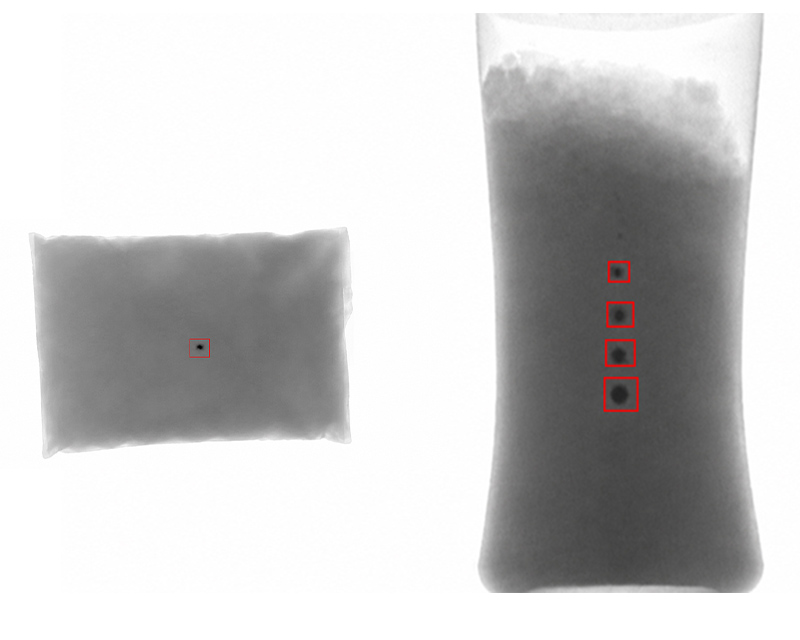
X-ray inspection works by leveraging the density of the object being examined:as X-rays pass through a product, they are attenuated to varying degrees—more significantly by higher-density materials and less so by lower-density ones. The higher the density of a material, the darker it appears in an X-ray image, and vice versa. Image processing software analyzes the contrast differences within the image to highlight contaminants or missing product components, subsequently triggering an output signal.
Not all foreign plastic objects can be detected. In some cases, the contrast between a low-density material and the food product itself may be insufficient; therefore, it is essential to test actual samples before establishing specific inspection requirements.
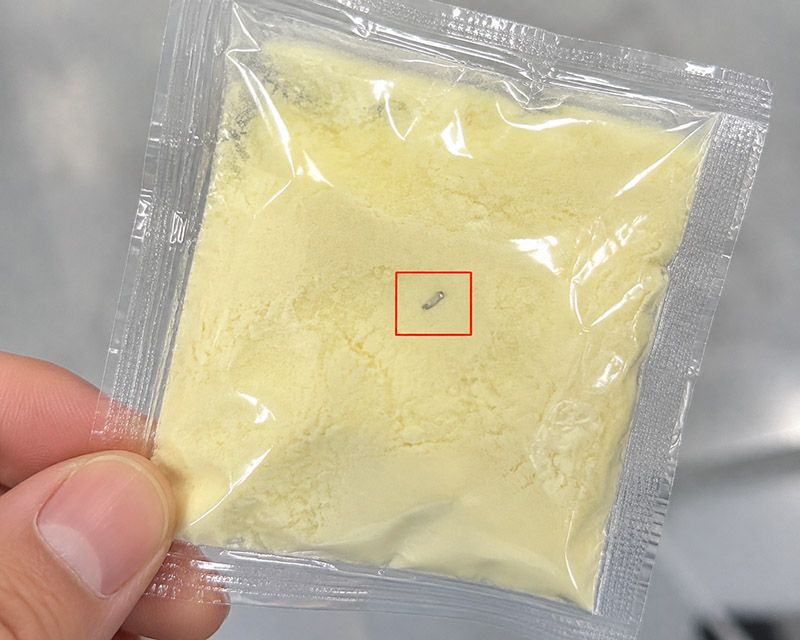
Why is it necessary to inspect packaged powdered food products?
Powdered food products are typically sold in bags, bottles, or cans. Since contamination can occur during processing or filling, inspecting the final product is a crucial step in quality control.
For packaged products, X-ray inspection technology offers two practical configurations:
1. X-ray inspection for bagged powdered products
General-purpose food X-ray inspection systems can be used to examine a wide variety of sealed, bagged products—such as powdered milk, flour, protein powder, cocoa powder, ground coffee, and seasonings.
These systems can identify foreign objects inside the packaging before the products move on to the transport and distribution stages.
2. Side-Illuminated X-ray inspection for bottled and canned products
For powdered products in bottles or cans, an inspection system tailored to the shape of the containers and the orientation of the products is required. Side-view X-ray inspection systems scan from the side, making them ideally suited for bottled and canned products.
The selection of an appropriate system depends primarily on the dimensions and weight of the packaging, as well as the type of foreign objects to be detected.
How Can X-Ray Inspection Help Reduce Food Waste?
Reducing food waste with X-ray inspection is not simply about rejecting contaminated products. It also involves making rejection decisions more consistent and reducing unnecessary product loss.
The following features help achieve this objective:
● Artificial Intelligence (AI) Image Recognition: Assists in analyzing X-ray images to identify potential foreign objects.
● Automatic Rejection: Automatically removes products deemed non-compliant (when a rejection system is configured).
● Image Archiving: Provides inspection records for quality audits and investigative analysis.
● Product Recipe Storage: Allows operators to easily retrieve saved inspection settings when switching between products.
● Continuous In-line Inspection: Supports real-time inspection during standard production processes.
To evaluate false rejections and prevent unnecessary waste, manufacturers should verify inspection settings using both compliant products and representative samples containing contaminants. By enabling the system to clearly distinguish between compliant products and those containing foreign objects, rejection accuracy is improved—thereby helping to avoid significant waste of food materials.
How Safe Is X-Ray Inspection of Food?
Food manufacturers may have concerns about whether X-ray inspection affects food safety or exposes products to harmful radiation.
In fact, X-ray inspection of food is a form of non-destructive testing. When conducted within the scope of applicable safety standards and regulatory requirements, it neither renders food radioactive nor leaves any radioactive residue in the products.
Modern industrial X-ray inspection equipment is equipped with protective shielding, safety interlocks, and radiation leakage controls, all designed to ensure the safety of operators. Food manufacturers should select equipment that complies with local radiation safety regulations and ensure that it is properly installed, maintained, and operated.
By adhering to these safety measures, food manufacturers can incorporate X-ray inspection into their foreign object control processes without any negative impact on product safety.
Production Speed and Application Considerations
Inspection capacity should match the packaging line rather than being selected independently of package size and product format.
The following are application reference ranges provided for these two packaging formats:
| Application | Conveyor speed | Reference throughput | |
| Standard bagged powder | 10–100 m/min | 60–120 packs/min | |
| Bottled or canned powder | 15–30 m/min | 60–80 containers/min | |
Actual throughput depends on the weight and dimensions of the packaging, as well as the production line configuration. For bottled and canned products, the height-to-diameter ratio of the containers should also be considered—both to minimize the risk of tipping during high-speed operation and to ensure that the selected equipment can accommodate the height of the containers.
Choose the Right X-Ray Inspection System for Powdered Food
Whether your factory produces milk powder, flour, protein powder, coffee powder, or seasonings, the inspection solution should match the final packaging format and contamination risks.
Histom offers two relevant options:
● Universal X-Ray Foreign Matter Detector for bagged powdered food.
● Side-Illuminated X-Ray Inspection Machine for bottled and canned products.
For a more detailed look at inspection applications, explore our Powdered Food Inspection Solution to understand how X-ray inspection can be applied to different powdered food products and packaging formats.
If you are evaluating X-ray inspection systems for your production line, please contact Histom and provide details regarding your product type, packaging dimensions, and production speed. Our team will assist in assessing your specific application requirements and recommend an appropriate inspection configuration for you.
Let's Customized Your Inspection Solution
Every production line is unique. Our experts will help you design a vision inspection system tailored to your products, packaging formats, and quality requirements.


