How Checkweighers Improve Food Packaging Quality Control
Accurate product weight is an important part of food packaging quality control. For packaged food manufacturers, products that are underweight, overweight, or missing components can lead to customer complaints, product waste, and production inefficiencies.
A checkweigher provides an automated solution for continuously checking the weight of packaged products during production. By measuring each product and comparing its actual weight with predefined weight limits, a checkweighing system can identify non-conforming products and automatically remove them from the production line.
What Is a Checkweigher?
A checkweigher is an automated weighing system designed to inspect the weight of individual products while they move through a production line.
Unlike manual weighing, which requires operators to periodically sample products, an automatic checkweigher machine can inspect products continuously without interrupting normal production.
The system typically measures the actual weight of each product and compares it with a target weight and predefined upper and lower tolerances.
Products within the acceptable weight range continue through the production line, while products outside the specified range can be automatically rejected.
Why Is Weight Control Important in Food Packaging?
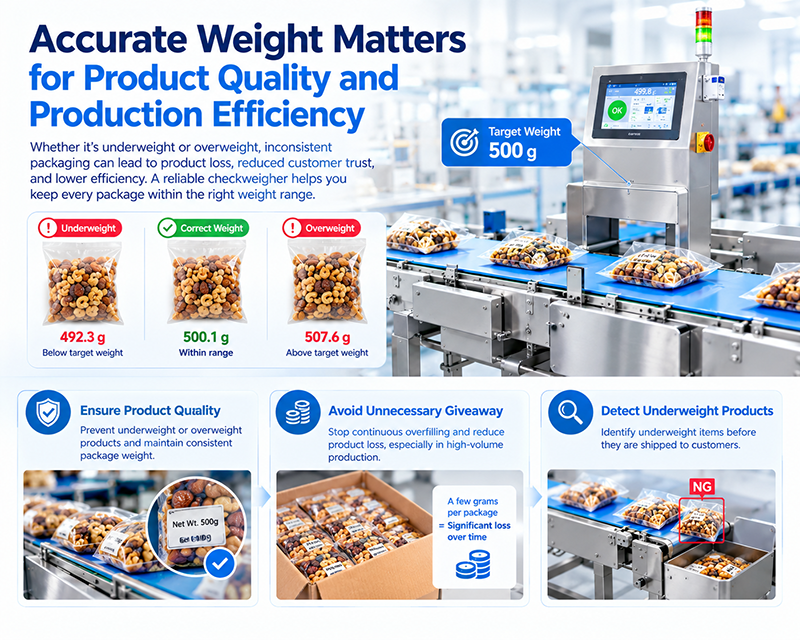
Accurate weight is important for both product quality and production efficiency.
Underweight products may fail to meet the manufacturer's declared quantity, while overweight products can result in unnecessary product giveaway.
For example, if a food manufacturer packages products with a target weight of 500 g, consistent overfilling by only a few grams can result in significant product loss when thousands of packages are produced every day.
At the same time, underweight products need to be identified before they are shipped to customers.
An automated food checkweigher helps manufacturers maintain more consistent product weight throughout the production process.
How Do Checkweighers Improve Quality Control?
1. Continuous Weight Inspection
A checkweigher can inspect every product passing through the production line instead of relying only on periodic manual sampling.
This allows manufacturers to identify weight deviations more quickly and maintain consistent control throughout production.
Continuous inspection is particularly useful for high-speed packaging lines where manually weighing every product would be impractical.
2. Automatic Rejection of Non-Conforming Products
When a product falls outside the predefined weight range, the checkweigher can activate an automatic rejection system.
Depending on the product and production line, different rejection mechanisms can be used, including pushers, air blast systems, flaps, or other automated devices.
This helps prevent underweight, overweight, or incomplete packages from continuing to the next production stage.
3. Reducing Product Giveaway
Overfilling can be a hidden source of production costs for food manufacturers.
For example, if every package contains slightly more product than the target weight, the additional product can accumulate into a significant amount of waste over time.
A dynamic checkweigher can monitor product weight continuously and provide manufacturers with more consistent control over filling accuracy.
This can help reduce unnecessary product giveaway while maintaining the required weight range.
4. Detecting Missing or Incomplete Products
Weight inspection is not limited to identifying simple overweight or underweight products.
A significant weight difference can also indicate that a package is missing a component or does not contain the expected amount of product.
For example, a packaged food product may contain multiple components, sachets, or pieces. If one component is missing, the total package weight may fall outside the predefined tolerance range.
A checkweigher can therefore provide an additional quality-control step for identifying incomplete packages.
Where Are Checkweighers Used?
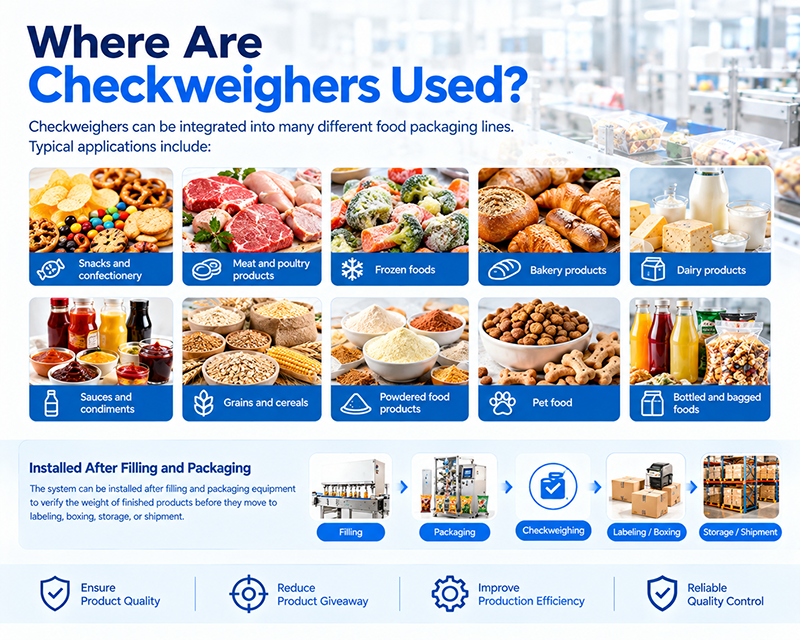
Checkweighers can be integrated into many different food packaging lines.
Typical applications include:
● Snacks and confectionery
● Meat and poultry products
● Frozen foods
● Bakery products
● Dairy products
● Sauces and condiments
● Grains and cereals
● Powdered food products
● Pet food
● Bottled and bagged foods
The system can be installed after filling and packaging equipment to verify the weight of finished products before they move to labeling, boxing, storage, or shipment.
Checkweigher as Part of an Automated Inspection System
A checkweigher does not have to operate as a standalone machine.
In modern food production lines, weight inspection can be combined with other inspection technologies to create a more comprehensive quality-control system.
For example, an integrated metal detection and checkweighing system can inspect packaged food for both metallic contamination and weight deviations.
The metal detector identifies potential metal contaminants, while the checkweigher verifies product weight. Products that fail either inspection can be automatically rejected.
This type of integrated system can save production space and simplify inspection on packaging lines where multiple quality-control requirements need to be handled in one process.
Benefits of Automated Checkweighing
Compared with manual weighing, automated checkweighing provides several advantages for food manufacturers:
● Continuous inspection of individual products
● More consistent weight control
● Automatic rejection of non-conforming products
● Reduced product giveaway
● Detection of underweight and overweight products
● Identification of potentially incomplete packages
● Better production-line efficiency
● Easy integration with automated packaging lines
The specific results depend on the product, production environment, machine configuration, and operating conditions.
Conclusion
Checkweighers play an important role in modern food packaging quality control. By continuously measuring the weight of individual products, they help manufacturers identify underweight, overweight, and potentially incomplete packages during production.
An automatic checkweigher machine can also reduce reliance on manual inspection and provide automatic rejection of products outside the predefined weight range.
For food manufacturers, selecting a checkweigher should take into account product characteristics, target weight, production speed, weight tolerance, conveyor configuration, and rejection requirements.
When integrated properly into a food packaging line, automated checkweighing can provide a more consistent and efficient approach to weight inspection and overall product quality control.
Let's Customized Your Inspection Solution
Every production line is unique. Our experts will help you design a vision inspection system tailored to your products, packaging formats, and quality requirements.


